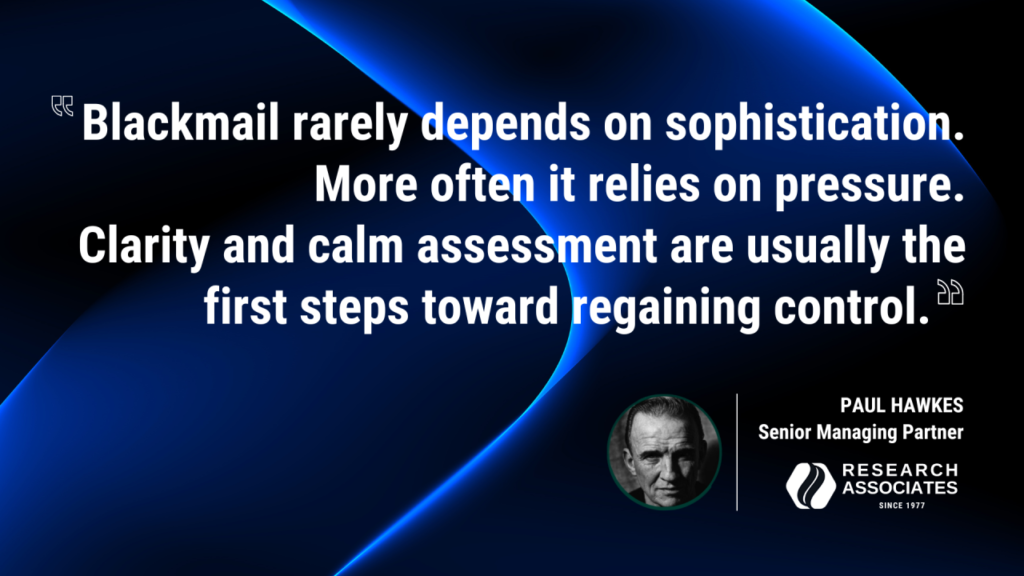
There are certain situations in life that people rarely expect to encounter until they find themselves in the middle of them. Blackmail is one of those situations.
In conversation, people often imagine blackmail as something dramatic or cinematic. It is portrayed as an elaborate plot involving shadowy figures and complex schemes. In reality, the situations that reach investigators are usually far more human, far more personal, and often far more emotionally difficult for the people involved.
After many years working in investigations, one of the things that becomes clear is that while every situation feels unique to the individual experiencing it, many blackmail situations follow recognisable patterns. The details differ, the personalities differ, but the underlying dynamics often share common features.
Understanding these patterns can be helpful. Not because it makes the situation any less serious, but because it allows people to step back and see the problem with greater clarity. When someone is under pressure, perspective may be difficult to maintain. Experience helps restore that perspective.
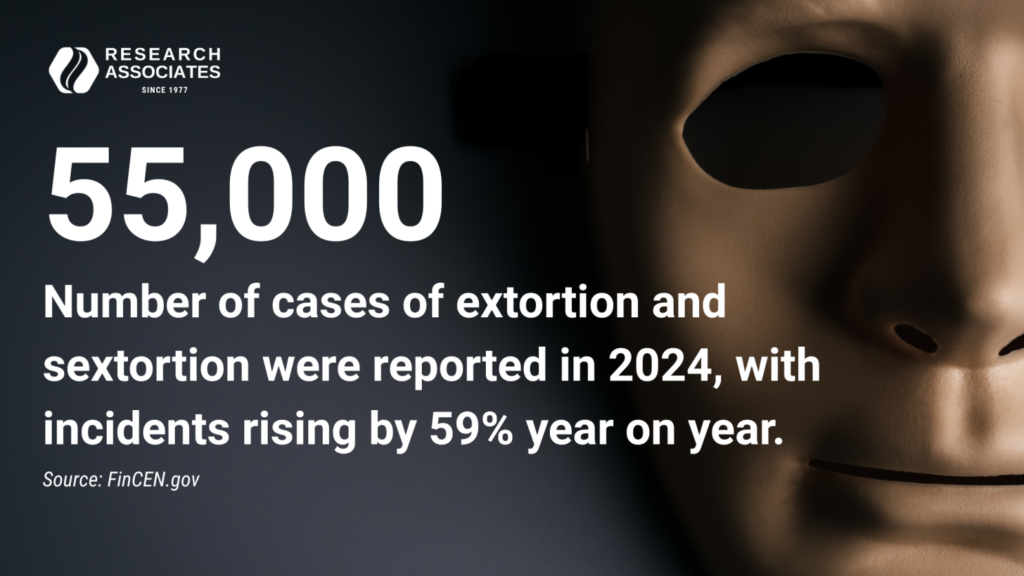
When Situations Become Personal
One of the first realities people encounter in these situations is how intensely personal they are.
Blackmail rarely arrives in a neat or predictable way. It tends to appear at moments when someone already feels exposed, uncertain, or vulnerable in some aspect of their life. That vulnerability might relate to a personal or private relationship, a professional reputation, financial matters, or private decisions someone believed would remain confidential.
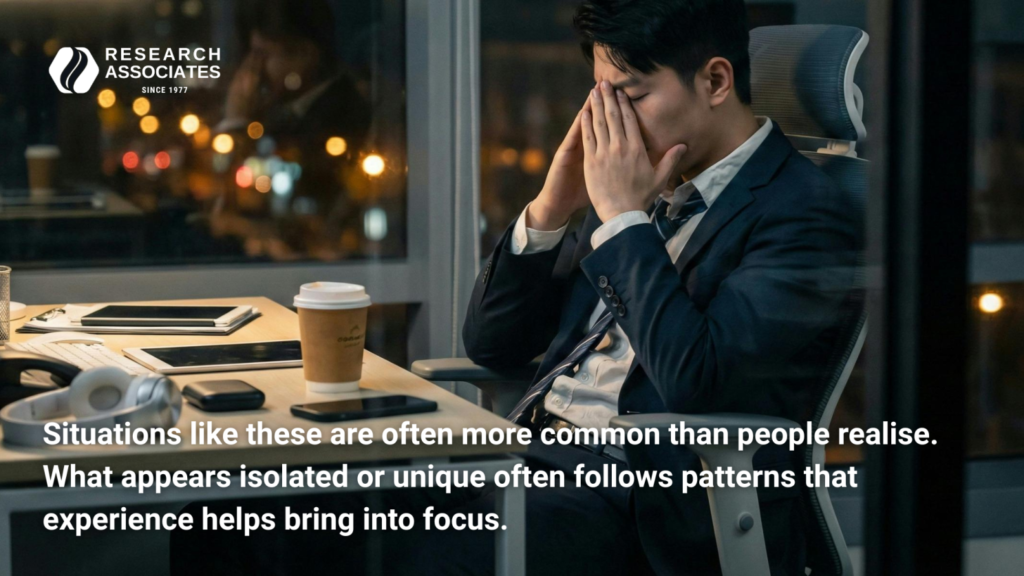
Because of this, people often feel isolated when it happens. They may believe they are the only person who has ever faced such a problem, or that the situation reflects badly on them personally.
In practice, specialist investigators see a wide range of circumstances. Many of them involve ordinary individuals navigating complex personal lives, careers, and relationships. The situations may feel deeply individual to the person involved, but the broader patterns behind them are often familiar.
Recognising that reality can be important. It allows people to move away from self judgement and focus instead on understanding what is actually happening.
The Misconception of Sophistication
Another common misunderstanding is the belief that blackmailers must be highly sophisticated individuals.
Popular culture tends to portray blackmailers as strategic masterminds who plan intricate operations. In practice, this is rarely the case. In many situations, opportunism plays a significant role. Individuals may identify a moment of vulnerability or access to information and attempt to exploit it rather than executing a carefully designed strategy.
More often than not, the behaviour involved is relatively simple. Pressure is applied directly, sometimes repeatedly, and often in ways that rely more on persistence than intelligence. The leverage being used may be real or exaggerated. The key element is the belief that continued pressure will eventually produce compliance.
What gives these situations their power is not complexity, but the emotional pressure they create. When someone feels their reputation, relationships, or personal life could be affected, it becomes difficult to think clearly.
This is one of the reasons perspective is so valuable in these circumstances. When situations are examined calmly, they often appear far less complicated than they initially seem.
Pressure and Escalation
What feels overwhelming at firstis often a situation that can be understood.Another pattern that becomes clear over time is the way pressure tends to develop.
In many cases, the first communication does not present itself as a fully formed threat. It may begin with a suggestion, a demand framed as a request, or a message that implies consequences without stating them directly.
If the situation continues, the pressure can escalate. Requests may become more urgent. The tone may change. The demands may increase and become more overt.
This gradual escalation is not accidental. It reflects a belief that continued pressure will eventually produce the desired response.
From an investigative perspective, one of the most important things to understand is that escalation often follows a predictable path. Recognising that path can help people respond in a more measured way.
Why These Situations Are Often Misunderstood
Blackmail situations are frequently misunderstood by those who have not encountered them before.
One reason for this is that the subject itself carries a degree of stigma. People often assume that if someone is being blackmailed, they must have done something particularly unusual or reckless.
It is also not uncommon for individuals who attempt blackmail to be involved in other unrelated activities or forms of criminal behaviour.
In reality, many situations arise from ordinary human behaviour. Relationships, private communications, business disagreements, or personal choices can all become points of leverage under the wrong circumstances.
The result is that people facing these situations may feel reluctant to speak openly about them. They may delay seeking advice, hoping the situation will resolve itself.
Unfortunately, silence and uncertainty can sometimes allow pressure to continue longer than necessary. In many cases, attempts to resolve the situation privately, including making payments, do not bring closure and may instead lead to further demands.
It is also not uncommon for individuals who attempt blackmail to be involved in other unrelated activities or forms of criminal behaviour. This is another reason why situations of this nature benefit from careful and structured assessment rather than reactive decisions.
The Importance of Perspective
One of the most valuable contributions an experienced investigator can provide in these situations is perspective.
When someone is directly involved in a blackmail situation, they are dealing with multiple pressures at the same time. There may be concerns about reputation, relationships, financial implications, or professional consequences. These pressures can make it difficult to assess the situation objectively.

An external perspective allows the situation to be examined more calmly. Instead of reacting to each new message or demand, it becomes possible to step back and assess the broader picture.
Questioning what is actually being claimed, what evidence exists, what risks are real, and what risks are being exaggerated become easier to evaluate when approached methodically.
Often, simply clarifying these elements reduces the sense of uncertainty that makes the situation feel overwhelming.
Misunderstanding the Role of Investigation
Another misconception relates to what investigators actually do in these situations.
Many people assume investigation is primarily about confrontation or dramatic intervention. In reality, the process is usually far more measured.
The first objective is understanding. Establishing the facts, assessing the credibility of claims, and identifying the nature of the pressure being applied are essential steps.
From there, the focus is on documentation, observation, and careful evaluation. The aim is to understand the situation clearly before any decisions are made.
This approach tends to produce better outcomes than reacting quickly without sufficient information.
Why Experience Matters
Experience plays a significant role in managing situations like these.
Investigators who have encountered similar dynamics before are often able to recognise patterns that may not be immediately obvious to those involved. They can identify when a situation follows familiar behavioural patterns and when it may require a different approach.
Just as importantly, experience allows investigators to remain calm in circumstances that may feel extremely stressful for others.
Maintaining that calm perspective is essential. It helps ensure that decisions are based on facts rather than pressure.
The Human Dimension
It is also important to remember that blackmail situations are not only legal or investigative matters. They are human experiences.
People facing these circumstances are often dealing with embarrassment, fear, threat, anger, or confusion. These reactions are entirely understandable.
One of the most important aspects of working in this field is recognising that reality. People rarely approach investigators when life is going smoothly. They do so when they are dealing with uncertainty or distress.
Approaching those situations with empathy and without judgement is therefore essential.
Moving Toward Clarity

If there is one lesson that experience consistently reinforces, it is the importance of clarity.
Blackmail situations tend to thrive on uncertainty. The more uncertainty exists, the more pressure can be applied.
When the facts become clearer, the situation often becomes easier to manage. Decisions can be made based on understanding rather than fear.
This is why the early stages of any investigation tend to focus on establishing what is known, what is uncertain, and what can realistically be verified. How can the blackmailer be persuaded to deescalate and ultimately contain their threat.
Once those elements are understood, the situation usually becomes far less opaque.
A Quiet Reality Behind the Headlines
Blackmail rarely resembles the dramatic scenarios often portrayed in films or television.
In most cases, it is quieter, more personal, and more emotionally complex than those portrayals suggest.
People who encounter Blackmail often feel alone, uncertain about who to speak to, or worried about how the situation might be perceived.
What experience shows is that these situations are rarely as unique or as insurmountable as they initially appear. With careful assessment and a calm approach, they can be understood and addressed in a structured way.
That perspective is perhaps the most valuable lesson experience provides.
Not every situation is the same, but the patterns behind them often are. Recognising those patterns allows people to move from uncertainty toward clarity, and from pressure toward resolution and containment.
And in many cases, that shift in perspective is the first step toward regaining control of the situation and neutralising the threat.
Learn More
For those interested in understanding more about how situations like these are approached professionally, you can explore the new Research Associates website, where we outline the areas we work in and the principles that guide our approach.
Call Now to Talk Through your Situation
Whether you require discreet surveillance, background checks, blackmail investigations, or corporate intelligence, our experienced investigators are here to assist.